South Korea’s Market Upswing in 2025: Reforms, Activism, and New Opportunities
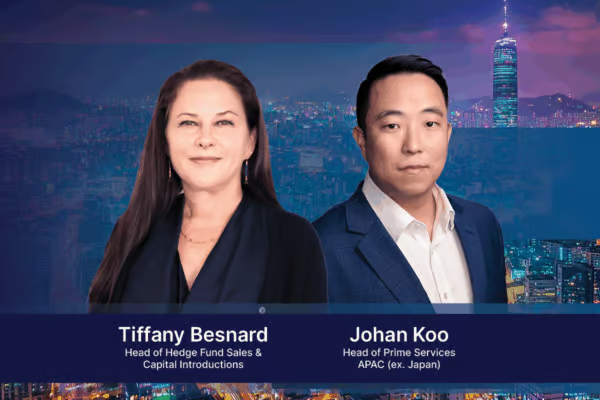
As South Korea’s markets undergo sweeping change, Tiffany Besnard and Johan Koo of 26 Degrees Global Markets bring a uniquely qualified perspective. Tiffany, Head of Hedge Funds and Capital Introductions, has years of experience working with global managers active in Korea, while Johan, Head of Prime Services APAC, is Australian born with Korean heritage and fluent in the language. Together, they combine their international expertise with local insight to assess the forces reshaping Korea’s financial landscape.
Overview: A Resurgent Korean Stock Market
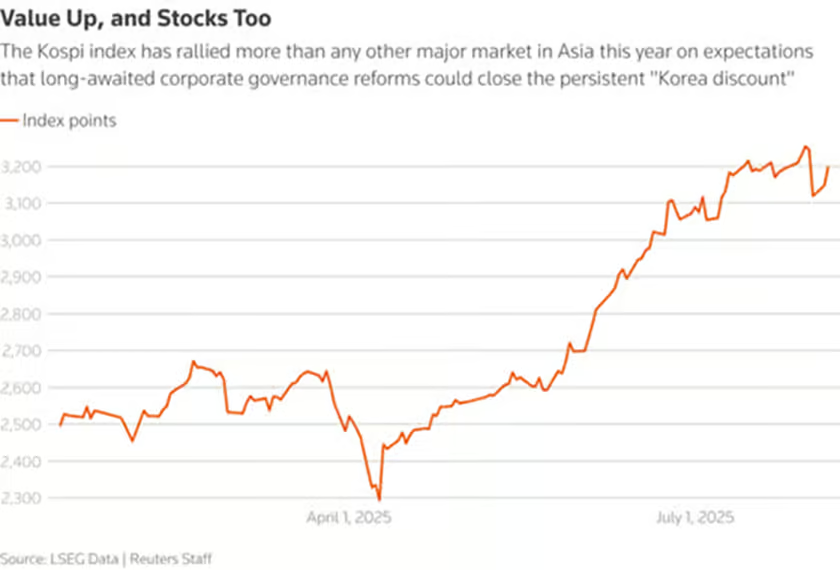
Tiffany Besnard: Global money is chasing Seoul at a pace not seen since the post‑GFC liquidity boom. Net foreign purchases of Korean equities topped US $3 billion in July 2025, capping a four‑month stretch of uninterrupted inflows and vaulting South Korea to the top of global fund‑flow league tables. The benchmark KOSPI has rallied roughly 33% year‑to‑date [1], easily out‑shining regional peers and inviting headlines that crown Korea the “world’s hottest major stock market” [2].
Yet this rally is not a simple momentum trade. It is the visible manifestation of deep structural change – one that I have been keeping careful watch over, especially after my interviews with managers Joon Ho (John) Byun and Young Kwang (YK) Joo from ANDA Asset Management, as part of our ongoing Fireside Chat emerging hedge‑fund manager series. “Policy‑makers have no choice but to strive to get rid of the Korea discount,” John Byun, Head of Engagement at ANDA, told me in May [3]. Back then his comment sounded ambitious, but three months later, reality has not only caught up but may be sprinting ahead.
Key Drivers Behind Korea’s Market Rally
Several powerful forces have converged to ignite South Korea’s stock market boom in 2025. Key drivers behind the upswing include:
Aggressive Corporate Governance Reform
Johan Koo: A wave of corporate reform is beginning to chip away at the long-standing “Korea discount.” Recent legislation has introduced meaningful governance changes: boards must now act on behalf of all shareholders, not just founding families, and new rules will soon limit the number of board seats controlled by insiders, while introducing cumulative voting to increase board independence.
Regulators are also weighing restrictions on treasury shares, which have historically been used to entrench control. At the same time, companies are showing signs of self-driven change: buybacks, dividends, and greater capital discipline are picking up. While external conditions remain mixed, the shift underway is structural, and it’s coming from within.
TB: All of this has fueled optimism that Korea is finally serious about closing its valuation discount. When I spoke to John Byun in May, he observed that foreign investors for years complained about poor governance – from low dividend payout ratios to boards that only served controlling shareholders. He believed the new reforms (such as expanding board fiduciary duty to all shareholders) could be a “turning point” and “milestone” in Korean corporate history [7].
In fact, Byun predicted early on that if the reform-minded opposition party won power, these governance changes would be swiftly enacted – which is exactly what has happened [8]. This focus on better governance and shareholder value is lifting market confidence and valuations across the board. Notably, despite this year’s rally, Korean equities still trade at one of the lowest valuations in Asia (around 10× forward earnings), leaving room for further upside as reforms unlock value [9].
Shareholder Activism and Retail Investor Power
JK: Alongside top-down reforms, a bottom-up investor revolution is underway. Korean shareholders, from large institutions to everyday retail investors have become far more vocal in demanding value. Nearly 30% of South Koreans now own stocks, up from only around 12% in 2019[10][11]. In raw numbers, the retail investor base skyrocketed from about 6 million to 16 million people in just the past few years, a dramatic change accelerated by the pandemic-era trading boom.
That means roughly one-third of the adult voting population are now stock owners [11]. As John Byun pointed out, policymakers “cannot really ignore the voice of retail investors” anymore [12]. This new generation of investors is savvy and globally minded – many of them trade U.S. tech stocks like Apple and Tesla, gaining exposure to international market standards [13]. They are unafraid to attend shareholder meetings and challenge corporate management on issues of governance and performance [13].
In short, cultural attitudes are shifting. Korean companies are increasingly expected to maximize shareholder value, and they face active ownership if they fall short. This grassroots activism complements the government’s agenda, creating a powerful one-two punch for closing the valuation gap once known as the Korea discount.
Lifting of the Short-Selling Ban
TB: Another recent development boosting market confidence is the return of short selling in Korea. For much of the past five years, South Korea had strict restrictions on short sales (a ban initially imposed in 2020), making it one of the last major markets with such rules. This ban was fully lifted as of March 2025, restoring the ability to short all listed stocks [15].
The resumption of short selling is widely seen as a positive for market quality and for attracting foreign investors. YK Joo, Head of Multi-Strategy at ANDA Asset Management, noted back in May that the ban’s end will improve liquidity, price discovery and fairness. With shorts back in play, “there’ll be more price discovery… more accurate valuations of companies,” leading to a “healthier, more robust market,” Joo explained [16][17].
With the short-sale ban lifted, many global allocators are re-rating Korea as an investable market. YK observed renewed interest from foreign investors once the ban removal and some political uncertainties were resolved – in his view, overseas allocators see a “better, healthier… more robust market to invest in” going forward [17]. Indeed, July saw a surge of international hedge funds and active managers returning to Korea, contributing significantly to the massive foreign inflows.
A potential upgrade from “emerging market” status
TB: One big question I hear from international fund managers is whether Korea will finally graduate from “emerging market” status. Johan has detailed the governance reforms boosting market confidence – and these same changes have not gone unnoticed by index providers. In fact, South Korea’s efforts to improve corporate governance and end its short-selling ban have strengthened the nation’s bid for an MSCI Developed Market upgrade [22].
Money managers were buzzing in June that MSCI might at least put Korea on its watch list for a 2026 reclassification, given the progress on market accessibility. Such an inclusion would be a game-changer, potentially attracting as much as $30 billion in passive inflows from index-tracking funds [23]. That’s a tidal wave of capital that could propel the KOSPI even higher and broaden the investor base.
The KOSPI 5000 Era
JK: Beyond structural reforms, investor sentiment is also being lifted by President Lee Jae-myung’s pledge to achieve a “Kospi 5000” milestone. Yet the challenge is that Korea’s housing market remains a gravitational force. Even amid the stock surge, policymakers have had to reimpose lending caps and residency rules, wary that investment gains could still spill into apartments.
The real bottleneck is supply. Seoul has long faced housing shortages due to strict redevelopment rules and slow approvals. Unless those barriers ease, a Kospi 5000 rally risks fuelling another property frenzy. Ultimately, the equity story cannot be separated from housing policy: sustainable progress requires reforms that support both markets, so today’s stock boom does not simply become tomorrow’s housing bubble.
How 26 Degrees Enables Access to Korea
JK: For global investors and fund managers eager to ride South Korea’s wave, navigating this market requires the right local access and expertise. 26 Degrees Global Markets is uniquely positioned to help hedge funds, family offices, and other institutional investors enter the Korean market seamlessly.
As an independent, multi-asset prime broker, 26 Degrees offers Direct Market Access (DMA) to the deep liquidity of South Korea markets through our synthetic Equities and Futures products, providing exposure to the KOSPI. Clients can establish both long and short positions without requiring an onshore presence. All activity is managed through a single, multi-asset margin account that consolidates positions across asset classes, enhancing margin efficiency while streamlining cash flow, collateral, and reporting operations.
TB: With prime brokerage services tailored to both emerging and established funds alike, 26 Degrees can also assist with capital introduction for managers looking to raise money for Korea-focused strategies – similar to ANDA Asset Management.
South Korea’s stock market upswing represents a compelling opportunity – but capturing that opportunity requires the right partner. 26 Degrees Global Markets acts as a gateway for foreign investors to confidently enter Korea. We combine global reach with on-the-ground understanding of the Korean market’s dynamics and microstructure. By leveraging our deep liquidity pools, cutting-edge trading technology, and experienced team, international funds can capitalize on Korea’s growth quickly, efficiently, and cost-effectively.
Disclaimer:
This material is intended solely for licensed brokers, dealers, or professional clients in jurisdictions where such communications are permitted. It is for informational purposes only and does not constitute a solicitation, offer, or recommendation to any person in any jurisdiction where such activities are prohibited by law.
Sources:
Recent market data and news from Bloomberg, Reuters, AInvest, Investing.com and Korea Joongang Daily were used to inform this analysis of Korea’s 2025 stock rally. Insights and quotes from industry experts John Byun and YK Joo of ANDA Asset Management provide context on Korea’s governance reforms, retail investor trends, and the impact of the short-selling ban lifting. These combined perspectives highlight the multifaceted reasons behind the Korean market upswing – and how 26 Degrees Global Markets can facilitate investor access to these opportunities.
[1] [4] [18] [24] South Korean Stocks See Surge in Foreign Investment Amid Regulatory Reforms
https://www.ainvest.com/news/south-korean-stocks-surge-foreign-investment-regulatory-reforms-2507/
[2] [5] [6] Global Money Chases World’s Hottest Major Stock Market in Korea | Bloomberg
[3] [7] [8] [10] [11] [12] [13] [14] [22] [23] Fireside Chat 7_ ANDA – John Byun Interview
https://www.26degreesglobalmarkets.com/hedge-funds/episode-7-anda-asset-management/
[15]South Korea to fully lift stock short-selling ban for first time in 5 years
[9] [19] [20]Blowout South Korea stock rally on a knife-edge over tax plans | Reuters
[16] [17] Fireside Chat 7_ ANDA – YK Joo Interview
https://www.26degreesglobalmarkets.com/hedge-funds/episode-7-anda-asset-management/
[21]Korean equity surge risks stuttering without stronger reform push | Reuters
[22] [23] South Korea Looks to MSCI Review With Renewed Hopes for Upgrade | Bloomberg
[24] [25] [26] [27] As Korea eyes Kospi 5000, housing supply in Seoul remains the missing link | Korea Joongang Daily
Insights
Latest insights from
26 Degrees






Insights
Latest insights from
26 Degrees