26 Degrees’ James Alexander on Hedging, Volatility, and 24-Hour Markets
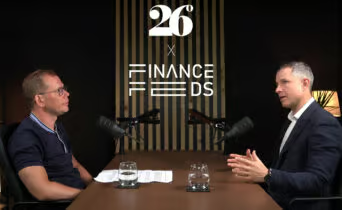
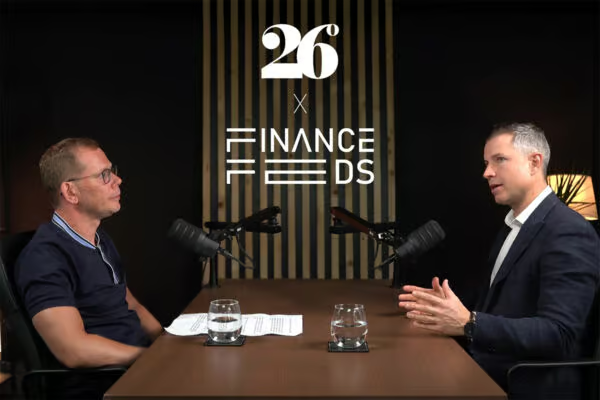
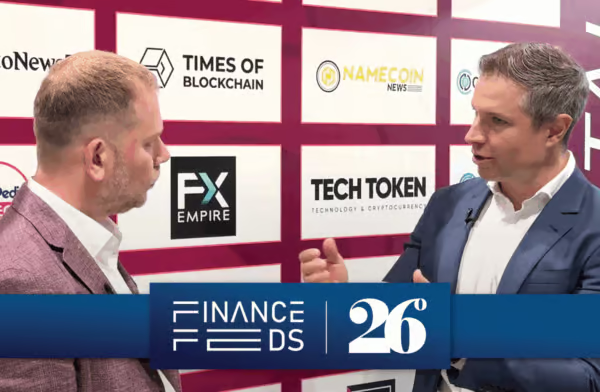
The episode featured James Alexander, Group Chief Commercial Officer at 26 Degrees, who offered an in-depth look into how the liquidity provider is navigating volatility, client hedging demands, and extended market hours. The conversation ranged from post-Trump market shocks and liquidity curation to the rise of pair CFDs and the practical use of AI in institutional trading workflows.
Alexander began by recalling how the market responded to the recent announcements from Donald Trump, particularly around tariffs. While the industry had been ready for potential volatility surrounding the U.S. election, the real disruption came later.
“The U.S. election was probably the most over-prepared event in the broking market,” he said. “Everyone was ready for that, but little were we to know the main game was still yet to come, which was those tariffs.”
He added that while brokers were prepared in general terms, the actual scale and breadth of the tariff measures surprised the market. “It’s fair to say the tariffs really did catch a lot of people by surprise. The market reaction shows that it was not well priced in. The volatility impacted a number of different markets – precious metals, indices – those really took a beating.”
According to Alexander, the precious metals market experienced a reaction similar to what was observed during the COVID period where movements of physical bullion were impacted. “It kind of played out in a way that was similar to what we saw over COVID. Then it was freight and logistics, this time, it was tariffs. But both times it raised the real or perceived cost of delivery into the U.S., which affects the cost structure for market makers and brokers in the Spot / OTC markets.”
These kinds of shocks hit brokers hardest when client flows are concentrated in just a few instruments. That’s the case today, Alexander noted, and it places extra stress on internal workflows.
“You’ve got this highly correlated, highly concentrated flow coming in,” he explained. “That traditional internalization and externalization model that brokers run does start to grind a little if they don’t have a really well-defined workflow for hedging internalized risk at scale. Hedging internalized risk in small parcels here and there is fine. But when you start moving in scale, in response to highly concentrated and rapidly accumulating risk, you’ve got to be able get out quickly and efficiently.”
In response, 26 Degrees focused on two areas: execution optimization and price stability. These have become priorities in recent months.
“We’ve seen a lot of price volatility, particularly in precious metals and indices,” Alexander said. “That can be challenging for retail brokers trying to deliver a stable, consistent product into their client demographics.”
He explained that 26 Degrees has implemented volatility-suppressing mechanisms, but with care. “We’ve focused on enhancing and implementing volatility-suppressing mechanisms within our pricing. But doing so in a way that doesn’t undermine the strength of the price in terms of its mid-rate reflection. Skewing of pricing isn’t a problem in isolation, but if done too aggressively it can create problems for the brokers who consume those prices.”
In practical terms, this also meant tightening liquidity pools to reduce market impact during high-volume hedging. “We’ve been very proactively curating (by curating, I mean reducing) the number of LPs in hedging-focused pools to really mitigate any market impact,” he said. “We talk a lot about value at depth, ensuring that when brokers hedge out in size, we’re providing value throughout the depth of the market. Not just top-of-book price. Top of book doesn’t help if your order size moves you through multiple price layers.”
The conversation then turned to which brokers adapted well to the new volatility, and which didn’t. Alexander was quick to note that the issue wasn’t a lack of sophistication, but a lack of preparedness for tail-risk scenarios.
“Some people lost, some people won,” he said. “Some people were prepared. Some weren’t. Others had the time or the flexibility to take action in real time, and that helped mitigate risks.”
He added, “You’ve got to be careful. A lot of our broker clients are very sophisticated. But what matters here is well-defined workflows. Many brokers didn’t drill tail-risk cases. They had solid A and B book segmentation, but weren’t prepared to handle dislocations like the ones we’ve seen.”
The recent disruptions only accelerated ongoing conversations between 26 Degrees and its broker clients, Alexander said. “Volatility is funny. You’re either dealing with too much or too little. There’s very rarely a sweet spot. What we had last year was a VIX at more consistently low levels and gold pushing higher daily. That creates a different kind of challenge, more about when to hedge.”
He recalled how the firm had been helping clients prepare even before the market shifted. “We were already working with brokers on optimal times to hedge. And then, Trump came in, and the script flipped. But the same relationships, the same open lines, helped us respond faster.”
To guide clients, Alexander described a simple but structured approach. “Do the brokers require a dedicated hedging feed? That’s one. Then value at depth – how good are your executions when moving size? Third, how efficiently do we, as the LP, handle those hedges? If we get those three things right, the broker is in pretty good shape.”

The interview also highlighted one of 26 Degrees’ key innovations: Pairs CFDs. This product provides traders with the ability to trade any two instruments against each other as a single instrument, just like an FX pair. Whether that be Metal vs Index, Commodity vs Commodity, Equity vs Equity, Pairs CFDs allow traders to go long in one instrument and short in another and express thematic views such as relative strength between markets, using simple instruments.
“There are clear thematic winners and losers now,” Alexander explained. “When Trump talks tariffs, you know that’s likely to be bad for Japanese automakers. That makes it bad for the Nikkei 225. So when you can trade the S&P 500 versus the Nikkei as a Pair CFD, you can action that clear theme easily.”
He continued, “That’s why we’ve seen increased demand for index pairs like those positioning U.S. indices vs. the Chinese or Japanese markets. We’ve also seen a lot of interest in Gold vs. Oil, especially with geopolitical factors at play. These instruments make complex situations executable as trade ideas more easily.”
Despite their rising popularity, he noted, the full rollout of Pairs CFDs is still ahead. “Uptake is growing, but the full rollout is still ahead. It reminds me of when we launched equities via API in 2017 – slow at first. But now it’s an essential part of every brokers offering. Pairs CFDs are going that way.”
Looking forward, the firm is also anticipating the shift to round-the-clock trading in U.S. equities. 26 Degrees already supports 16-hour trading, and Alexander believes this is only the beginning.
“Brokers should be prepared. The world is going that way,” he said. “We recently pushed U.S. equities to 16 hours. But internally, the conversation was already, ‘We need to be ready for 23 hours.’”
He expects the change to come soon. “My view is we’ll be at 23-hour trading for U.S. equities, five and a half days a week, early 2026 for sure. Getting to 24/7 will take longer, partly dependant on trade reporting and clearing timelines.”
However, the infrastructure must be in place. “When the exchanges are there, we’ll be there day one. But we prefer to rely on regulated exchanges as price sources. We don’t want to rely solely on ATSs, even if some of them are already pricing 24 hours.”
Finally, Alexander discussed the role of AI in post-trade analysis and internal decision-making. While not used for automated execution or risk controls, AI now plays a major role in supporting 26 Degrees’ traders and analysts.
“We are proactively looking at how we can integrate more AI,” he said. “A number of workflows now rely on AI components. But there’s still a governance angle, how much do you trust what goes in and what comes out?”
He clarified, “For now, AI is helping with post-trade analysis, analyzing data, volatility, trade flow, netting percentages. But it’s about informing the humans—empowering them. That’s where it’s strongest.”
To close the episode, Alexander offered a metaphor that summed up the shift the industry is undergoing: “Two, three years ago, we were in comfort mode. Now we’re in sport mode. The car has to be efficient in both.”
And for him, strong relationships remain the real edge. “What separates a good operator from a great operator is the ability to say, ‘Guys, here’s what I’m seeing. Can we get something in place, even if just for the next few months?’ That’s the kind of value add that matters now.”
If you’re interested to learn what 26 Degrees can do for you, click the button below:
Reach out nowInsights
Latest insights from
26 Degrees






Tier 1 Prime Broker relationships supporting three and four way give-ups





Industry Leading.
Globally Recognised.