

Asia’s Evolving Hedge Fund Landscape
Over the past two decades, the hedge fund industry in Asia has undergone significant transformation. While multi-strategy mega-funds have grown in scale and visibility, emerging managers with focused, niche strategies continue to capture the attention of allocators seeking differentiated returns.
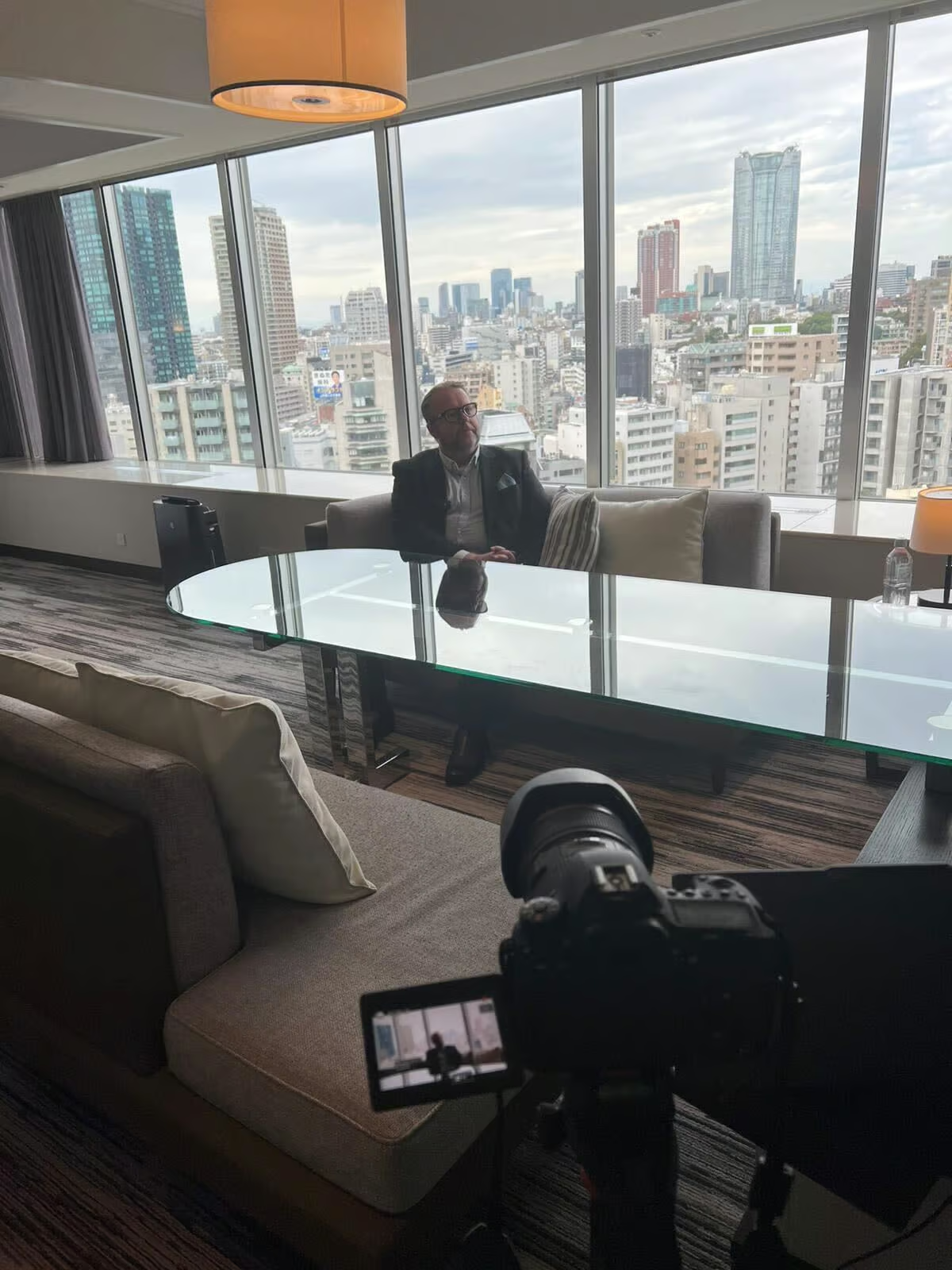
In a conversation with Tiffany Besnard, Head of Hedge Funds at 26 Degrees Global Markets, Stefan Nilsson, Founder of the Hedge Funds Club and CIO & Co-Founder of Terrasias Capital Ltd, shared his perspective on these developments, highlighting both the opportunities and challenges facing investors and fund managers today.
The Rise of Multi-Strategy Mega-Funds
One of the most striking changes in the Asian hedge fund market has been the proliferation of multi-strategy funds.
“They used to be single multi-strategy funds,” Stefan explains, “but now you have mega-billion fund houses with pods, sometimes hundreds of portfolio managers.”
While these funds bring scale and operational sophistication, Stefan notes that the growth comes with trade-offs. This concentration of talent and capital has also fueled spinouts, with experienced managers leaving large firms to establish their own funds, a trend increasingly visible in Asia.
“It becomes a bit like a factory,” he says. “As an investor, I look at these things and think, It’s like the big banks. That scale can be both good and bad, depending on what an investor is seeking.”
Why Smaller, Niche Managers Matter
Despite the dominance of large funds, Stefan emphasises that many allocators remain interested in smaller, differentiated managers and stresses that investors prioritise quality and uniqueness over sheer scale.
“If someone approaches me saying, ‘We run a $40 billion fund, let’s talk,’ my reaction is no. But if a manager launches a fund with $20 million and clearly explains why they are different, I’m interested,” he says.
Tiffany echoes this perspective, noting that her recent interactions with large family offices and fund-of-funds in New York confirmed growing interest in Asian niche managers.
“Allocators are actively looking for high-quality, smaller managers who can generate alpha in interesting segments of the market,” she explains. “It reinforces what we’ve been focusing on in capital introduction identifying managers with differentiated strategies and a strong track record.”
Due Diligence Is Key
Stefan emphasises that the performance of a few underperforming funds should not define the asset class and stresses that investors must conduct proper due diligence:
“A US pension fund recently redeemed all their hedge fund investments and claimed hedge funds aren’t worth it. I thought: they allocated poorly and are now blaming the entire asset class. That’s not fair,” he says.
If you’re a fund manager or hedge fund allocator and would like to find out more, explore our Fund Manager and Allocator pages, or get in contact with our team:
Get in contactInsights
Latest insights from
26 Degrees






Exclusive Content
Interviews with our fund manager network
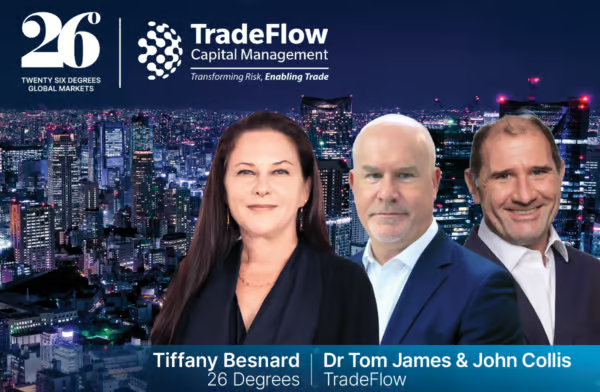

Fireside Chat - Episode 8: Blue Creek Capital
Tiffany Besnard sits down with Bill Baruch, the Founder and President of Blue Creek Capital Management, Blue Line Futures, and Blue Line Capital.The pair discuss the current macro environment, inflation and how metal additions to a traditional portfolio can contribute to diversification.

Fireside Chat - Episode 6: Antiloop
Founded in 2020, Antiloop is a multi-strategy hedge fund which combines several different asset classes using a quantamental approach.The company manages two funds: Atlas, a multi-strategy fund with a systematic-discretionary approach targeting 7-10% yearly volatility and double-digit returns, and Cygnus, a tactical asset allocation strategy with a focus on commodities targeting 10-15% volatility.

Fireside Chat - Episode 5: Alpha Alternatives
Prashant Kothari is the Founder and CEO of Alpha Alternatives Singapore, a multi-asset class, proprietary capital investing, and asset management platform driven by a commitment to alpha generation and strategic partnerships.The firm is dedicated to reshaping the asset management industry by transitioning from an AUM led model to one that is performance led and charged.
Episode 4: Golden Horse Fund Management
In this edition, Head of Hedge Funds Sales APAC and North American, Tiffany Besnard, sits down with Lawrence Chen, Co-Founder and CEO of Golden Horse Fund Management.Regulated by the Monetary Authority of Singapore, Golden Horse Fund Management, harnesses the power of predictive analytics, artificial intelligence (AI), machine learning (ML) and quantitative investment strategies, alongside leveraging advanced mathematical modelling, computer systems and data analysis in the continuous pursuit of alpha.

Fireside Chat - Episode 3: Blue Fire AI
In this edition, Global Head of Prime, Hedge Funds Andrew Bradshaw sits down with Samir Rath, CEO of Blue Fire AI to discuss ‘Emmalyn’ the world’s first autonomous active asset manager.The Emmalyn long short US equity absolute return strategy has been in stealth mode with a very large US platform and is being launched this year for wider distribution to allocators looking for best in class absolute return products.
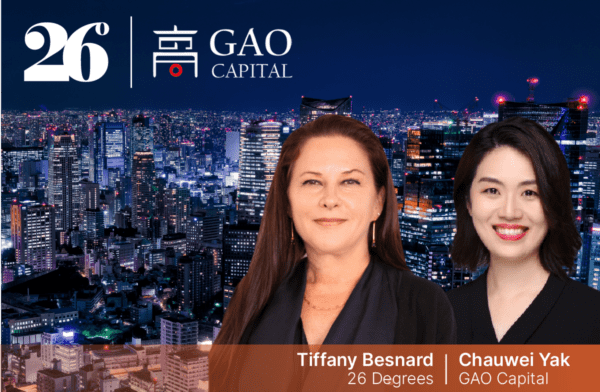
Fireside Chat - Episode 2: GAO Capital
Our second Fireside chat is with Chauwei Yak, Founder and Chief Executive Officer at GAO Capital, an alternative Singapore-based asset management firm founded in 2008 with family office roots.The interview will discuss Chauwei's Always Seek Value Fund (ASV), a multi-manager, multi-strategy equity fund focused on Asia. The Fund seeks uncorrelated results to the Asian equities market and diversification of opportunities within the region including Japan and India.

Fireside Chat - Episode 1: Blue Orca Capital
Our first Fireside chat is with Soren Aandahl, Chief Investment Officer at Blue Orca Capital. Blue Orca specialises in providing a market neutral, short selling activist strategy.The firm also performs investigative research on public companies in APAC and the US.