Gold Volatility, 23-Hour Equities, and Global Market Shifts
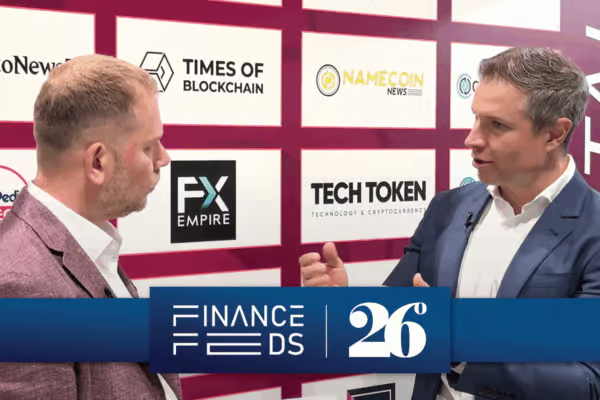
At iFX EXPO Asia in Hong Kong, FinanceFeeds Editor-in-Chief Nikolai Isayev sat down with James Alexander, Group Chief Commercial Officer at 26 Degrees Global Markets, for a wide-ranging discussion on metals volatility, extended-hours U.S. equities, evolving regulatory environments, and the company’s expanding product suite. The conversation took place against the buzzing backdrop of one of the industry’s most important global gatherings, offering a timely deep dive into the biggest themes shaping brokerage infrastructure and retail trading behaviour today.
For readers unfamiliar with 26 Degrees (formerly Invast Global), the Australian-based firm provides multi-asset liquidity, prime services, credit access, risk management technology, and low latency connectivity solutions for brokers worldwide. Over the past year, the company has accelerated its product pipeline—rolling out 16-hour U.S. equity CFD trading, expanding its Pairs CFDs and Commodities lineup, and reinforcing its prime broker network to six PBs. These moves have positioned 26 Degrees as a top-tier liquidity and infrastructure partner for brokers seeking resilient access to markets in periods of volatility and structural change.
The interview covered a broad spectrum of industry touchpoints: the surge in precious-metals trading, concentration and hedging risks, the race toward 23- and 24-hour U.S. equity trading, shifting demand across Asia and the Middle East, cross-regional regulatory expectations, the design of new CFDs, and the emerging arena of predictive markets. Below are the session’s key highlights.
Gold Dominates Trading: Concentration Risk Emerges as the Industry’s Biggest Challenge
The conversation began with the extraordinary dominance of metals trading this year, especially gold. Alexander explained that the move has been sharper and more sustained than typical cycles, capturing the attention of global retail traders.
He pointed to the explosive volume shift: “We generally see around 60 to 70% of broker flows at the moment coming through in precious metals, predominantly gold.”
This level of flow concentration, he emphasized, has created pressure points for brokers and infrastructure providers. While surging retail engagement normally boosts liquidity, the sheer magnitude of the move increases systemic exposure. Alexander described the phenomenon as both predictable and destabilizing: “This asset price increase has been very aggressive. When you get a move like that, it isn’t surprising to see significant retail participation — but it does create significant concentration risks for brokers.”
Silver has displayed its own resurgence as traders look for relative value plays. He highlighted how the divergence between metals created a wave of speculative opportunity: “Silver lagged gold for a while, and that divergence grabbed a lot of attention. Retail participation loves a trade like that.”
The firm’s ability to navigate these conditions stems from long-term infrastructure planning, particularly around access to credit and diversified liquidity sources. Alexander noted that 26 Degrees’ multi-prime setup is proving essential during high-stress periods, as is the firm’s emphasis on stable, filtered pricing during thin liquidity windows.
Hedging Under Stress: How Infrastructure and Relationships Shape Outcomes
As metals volatility rose, so did the importance of hedging efficiency. Alexander acknowledged that today’s environment demands more from both systems and counterparties. While directional retail markets will always pressure liquidity channels, preparation determines how effectively providers can adapt.
He noted that 26 Degrees’ multi-location setup is a critical advantage: “We have trading servers in New York, London, and Tokyo, and we centralize risk across those locations. That lets us achieve far more netting and reduces the need to hit external liquidity.”
This centralization reduces pressure during retail one-way markets, but Alexander made clear that even the most advanced setups still rely on strong liquidity relationships. In fast markets, credit lines, execution continuity, and availability matter as much as spreads.
The overarching message: hedging today requires not just tools but ecosystems and trusted relationships.
Extended-Hours U.S. Equities: A Measured Strategy Toward 23-Hour Trading
One of the most anticipated topics was the global race toward nearly around-the-clock U.S. equity trading. With 24X receiving approval to launch extended hours US equity trading, the industry has been waiting to see whether major liquidity providers will accelerate their rollout. Alexander made the firm’s stance clear: 26 Degrees intends to move forward only once exchange-level liquidity becomes available.
He explained the decision with notable precision: “We’ve made the strategic decision to wait for exchange-venue liquidity. Once DTCC clearing and reporting go live in 2026, exchanges will push to 22, or 23hour trading — and that’s the moment we’re targeting.”
The priority, he stressed, is protecting brokers who rely on 26 Degrees as a primary pricing source for U.S. equities. That requires dependable, regulated, multi-source liquidity—not relying solely on pricing from ATS venues.
Despite this strategic patience, the firm’s 16-hour U.S. equity trading—launched earlier this year—has already become one of its most successful product rollouts. “Since launching extended hours in April, we’ve seen a near doubling in U.S. equity volumes. That tells us the demand is real and growing.”
The strongest appetite comes from Asia, where extended hours directly overlap with local trading days. Alexander said the demand in Hong Kong, Japan, and Korea has been overwhelming, and the moment regulated exchanges open the full window, 26 Degrees intends to be among the first to deliver it to brokers and hedge funds.
26 Degrees Expands Product Set, but Predictive Markets is Out of scope
U.S. equities may be globally popular, but Alexander emphasized that different regions are driven by different motivations. In Asia, traders want live access during local evenings. In Europe, brokers value the improved hedging windows. In the Middle East, U.S. equities sit alongside deep interest in commodities.
This global adoption has reshaped how providers think about product delivery. Alexander described the shift as a genuine globalization of trader behaviour—one that crosses cultures, time zones, and regulatory frameworks.
The interview also examined 26 Degrees’ expanding product set. Commodities and Pairs CFDs have been especially successful in the Middle East, where local familiarity and market culture heighten engagement. Pairs CFDs, an innovative new product built in-house by 26 Degrees, allow traders to speculate on the relative performance of two assets within a single instrument, offering a more targeted way to express views on market relationships. This structure has resonated strongly in markets where comparative trading strategies are already widely understood.
Meanwhile, Japan and Korea have displayed strong demand for equity-linked Pairs as well as unexpected commodities such as soybeans—highlighting the outsized influence of local consumer markets on retail trading preferences.
Alexander said that regulatory complexity across regions does not limit product innovation but rather shapes how products are delivered. “Different regulations don’t mean good product design needs to be thrown out. You must design products that are interesting, understandable, and tradable — then deliver them in a way that fits the local regime.” Client feedback, he added, is a consistent driver of the firm’s roadmap.
The conversation closed with the rise of predictive markets, which have accelerated rapidly in the U.S. Alexander acknowledged the trend but said it does not align with 26 Degrees’ business model.
“It’s a brave new world… but it’s not something we’re focusing on as a business.”
He noted the intellectual appeal of predictive analytics but reinforced that the firm’s priorities remain institutional-grade market access and product integrity.
Insights
Latest insights from
26 Degrees







Tier 1 Prime Broker relationships supporting three and four way give-ups





Industry Leading.
Globally Recognised.